The Inspired View Beyond Our Survival Matrix
Guardian Presence shifts Threat-Prey-Escape Thinking into Grounded and Empowered Presence
SUMMARY: We often get trapped in the Prey–Threat–Escape drama triangle without even realizing it, repeating the same emotional patterns that drain connection and clarity. It happens with work, family, and our inner life. This article reveals how the Guardian Presence shift offers a grounded alternative—helping you move from reactivity to relational strength and intention.
Part 1: Ancient Armor for Modern Problems
Most internal and relational setbacks occur before we even know what is happening. Relying on our gut doesn’t improve our chances. Our instincts are bent toward one overarching goal – survival. But emotional growth and cognitive awareness can lead us into a Guardian Presence that leads to a richer way of being.
The survival lens is inherited, embedded, and fiercely protective. We are the latest link in a long chain of survivors. Our ancestors crossed mountains and deserts, fled persecution and famine, braved pandemics and unthinkable hardship. We are only alive today because generations before us mastered the art of staying alive against incredible odds. Survival not only required robust physicality, but also social-emotional skills to remain part of the group. We did not survive on our own. We found ways to serve and be served by a diverse social group. After generations, here we are.
By that logic, our survival system is more refined than at any point in human history. Which also means this: to ignore, lower, or disarm that system feels unnatural. Even dangerous. For many of us—especially those who endured chaotic childhoods, unreliable caretakers, abuse, violence, betrayal, or profound emotional harm—“letting down our guard” can feel like flirting with disaster. Survival isn’t just an instinct; it has been the scaffolding that held our world together.
So we walk into adulthood wearing ancient armor for modern problems.
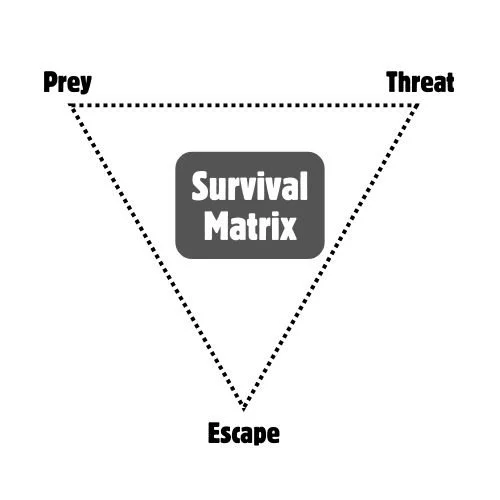
Diagram 1. Survival Matrix Triangle
The Survival Matrix is a mode that doesn’t see nuance, motive, or meaning. It sees three things: Threat. Prey. Escape.
This is the internal logic of a human body and nervous system designed to keep us alive.
In psychology, Dr. Stephen Karpman identified the Persecutor, Victim, and Rescuer as the Three Faces of Drama, or the Drama Triangle. When we operate from the desperation of the Survival Matrix, we instinctively cast ourselves, others, and circumstances into these roles.
The Threat/Persecutor is anyone or anything that feels like it’s taking from us, hurting us, disappointing us, or blocking what we need.
The Prey/Victim is the one who absorbs the pain, is disempowered and helpless due to feelings of being trapped, overwhelmed or wronged.
And the Escape/Rescuer is the person or outlet that relieves the unbearable tension through distraction, fixing, numbing, controlling, blaming, or shutting down.
This Survival Matrix becomes a revolving stage that plays out everywhere: with a coworker who “never listens,” a spouse who “doesn’t understand,” a supervisor who “doesn’t support us,” a teenage child “pushing our buttons,” or in the quiet battles inside our own head.
In the Survival Matrix even calm is temporary and inadequate. Because where there are winners and losers, peace cannot last.
A Small Story of How Fast It Happens
It is easy to find examples of the Survival Matrix or Karpman’s drama triangle. Remember, the Prey is the victim experiencing some loss or discomfort instigated by some Threat who is causing the hardship. This tension will eventually be relieved by the Escape that provides a release to the tension. A recent event comes to mind from my life.
This last October, the Seattle chill and the outdoor temperatures took their familiar dip and within my house it unexpectedly followed. My wife noticed the chill and calmly made the observation—though I recognized a hint of panic. As she gathered blankets and started a fire, she quizzed me about what was wrong. The heat pump was cycling but refusing to turn on. I didn’t know how to fix it. Her discomfort grew. My anxiety grew. So I assured her I would call the HVAC company first thing in the morning – secretly hoping the system would make a sudden recovery and kick on.
The unit clicked on and off. Hope dissolved.
Notice the three roles.
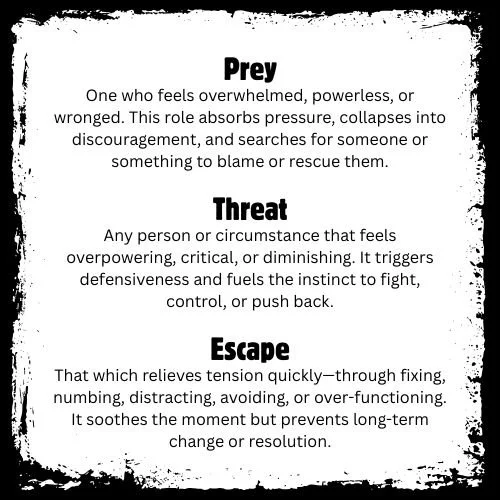
Chart 1. Survival Matrix Roles
Prey: My wife, freezing and miserable.
Threat: The broken heat pump.
Escape: Me, promising to call the HVAC company.
Five minutes later, the roles rotated:
Prey: Me, feeling the pressure to solve something I couldn’t.
Threat: Her frustration and expectation.
Escape: The argument tempting its way into the room.
We moved through all three roles without even thinking. And that’s the point—the Survival Matrix is our default, our automatic operating system.
Unless someone shows us another way, this becomes the story of adulthood: reacting, defending, rescuing, attacking, withdrawing… over and over and over.
The Invitation To See The Roles
These roles have been present since we were young and they are readily recognized in their childish origin. But we don’t leave them behind just because we get older. They continue to color every one of our lives. As we move through our adult years and approach the middle years, we are invited to an awakening. After all these years are we ready to accept the limits of these patterns? We’re exhausted from trying to fix everything, manage everyone’s emotions, outrun disappointment, avoid pain, and cycle through the never-ending drama story. We sense there has to be a different way to relate to ourselves and the people we love.
Think back to the last conflict, tense or drama-filled moment you had with someone you care about.
It doesn’t need to be explosive—just a moment of feeling misunderstood.
Ask yourself:
Who was the person (or situation) that took my sense of power and control away?
How did you seek to protect yourself from further hurt, frustration or being overwhelmed?
What relieved the tension of the moment? Was it a distraction, quick fix, withdrawal, or something else?
Which role – Prey, Threat, or Escape – do you find yourself most familiar with?
The question here is not whether these roles were present—they always are.
The question is whether you can see them. The doorway out of the Survival Matrix is found when we recognize them in our life, then we have a chance to exit the drama and initiate something new.
What makes the drama triangle so invasive is these roles are not limited to external interactions and individuals. We are immensely creative and can operate an internal version of these roles. We cast and play out the drama on the inner stage of our life. Our inner critic is the Inner Threat. We feel helpless or confused by the Inner Prey. Unwanted or unhealthy behaviors exacerbated by stress are forms of the Inner Escape. Our ability to internalize the Survival Matrix reveals true human ingenuity. This inner manifestation distorts both our ability to read relational dynamics accurately and to make grounded decisions.
This Survival Matrix pattern is deeply human, but it is not the only way to live. And this is exactly where Guardian Presence enters with a new map—a healthier, more grounded way to navigate tension, conflict, and emotional stress. Before we move into the alternative, let’s look at practical examples of how the Survival Matrix can show up in a marriage, parental dynamics and in the workplace.
Example: An Evening of Marriage Disconnection
Let’s consider an example that may land close to home. Jordan comes home after a long day, hoping for a peaceful night. His wife is visibly stressed, the kids are loud, and dishes are piled up. His wife says, “I feel like I carry everything around here.”
Consider how the three roles show up. From the Survival Matrix viewpoint, the comment feels like an accusation. Jordan hears it as blame, interpreting it as a Threat.
Jordan entering the Prey role shuts down internally: “I can’t ever do enough. I’m already exhausted.”
Needing an Escape from the tension, Jordan starts cleaning frantically to “get things done,” hoping it fixes things.
These roles are fluid, and after a lifetime of utilizing these for survival there is an instinctive shift. A few minutes later, Jordan snaps, “You act like I’m doing nothing!” Now Jordan becomes the Threat, and his spouse becomes the Prey.
His wife is overwhelmed by the conflict, seeks an Escape and goes to the bedroom to scroll on her phone – temporarily relieving tension, but not resolving anything.
The dance will continue.
Intimate relationships are filled with innumerable disagreements due to the Survival Matrix.
What might this look like between adult-age kids and their parents?
Example: Caring for an Aging Parent
James has been trying to help his aging father keep track of medications and upcoming medical appointments. His father becomes irritated, insisting he’s “fine” and doesn’t need any help. The tension rises quickly.
His father’s resistance feels sharp and dismissive, triggering the Threat reaction. The curt reply lands like an attack on James’s effort and concern.
James feels helpless and discouraged: “I’m trying to support him. Why does it have to be this difficult?” The need to survive kicks in as the Prey.
Finding an Escape by lowering the tension, James backs off entirely, relieving the immediate friction, but increasing his long-term stress and resentment.
Again, the roles can and do swap. Later that evening, his father mutters, “You’re always treating me like I can’t do anything on my own.” In that instant, his father feels like the Prey and James becomes the Threat. When his sister steps in, she offers the Escape when she says, “Don’t worry, I’ll handle it.”
Did anyone ask to fill their role? How did these dynamics get assigned? Very simply, they are deeply ingrained in our emotional survival and offer a familiar dance that ends in pain and ironically, reinforces disconnection and distrust.
The Survival Matrix can also show up outside of family in relationships with those whom we work.
Example: Conflict with a Work Supervisor
Officer Daniels is at the end of a long week with a lot of calls and a ton of paperwork. His sergeant calls him into the office and points out several missing details in a report. The sergeant’s tone feels sharp and corrective and Daniels interprets it as criticism. And this initiates a Threat response internally. Daniels feels attacked and misunderstood as the Prey and thinks, “I can’t ever get it right. Why is he always on my back?” The Escape emerges as he tries to quickly fix the report and minimize conversation, hoping the problem will go away. Internally, he mentally checks out, telling himself, “Forget it—just get through the shift.”
When Daniels abruptly turns and leaves, the sergeant becomes frustrated that Daniels didn’t adequately respond and felt his departure was disrespectful. The sergeant raises his voice to which Daniels fires back with sarcasm. A fellow officer walking by pops his head into the office with a timely distraction, “Hey Sarge, I got that info you were asking for.” The drama triangle shifts: Daniels becomes the Threat, the sergeant becomes the Prey, and the officer interrupting the exchange offers the Escape.
These are three simple examples of how the Survival Matrix shows up in our marriage, family relationships, and workplace. It defines our intimate relationships and the folks we cross paths with in the course of the day. Can you recognize it in your life?
It can shape relational dynamics with those we know well or a complete stranger we interact with in the store. And can happen out of public view in our inner world. Private self-critiques like, “You are so lazy… You eat too much… You embarrassed yourself by what you said… You messed up again” are Inner Threats readily wounding the soul of the Inner Prey and relieved by Inner Escapes.
Three Roles Inventory
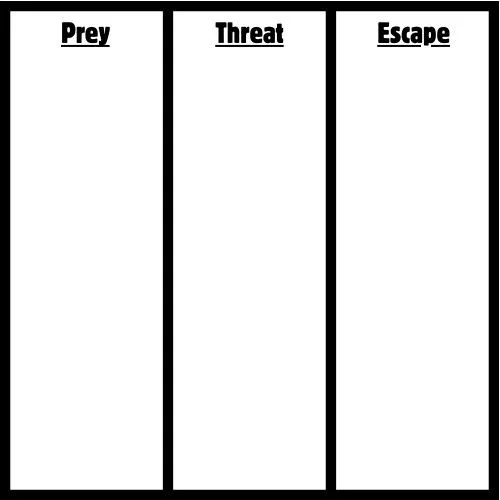
Chart 2. Three Roles Inventory
Inevitably you have begun to recognize these three roles in your own life. As mentioned earlier, once recognized, it is difficult not see the Prey/Victim, Threat/Persecutor, and Escape/Rescuer in drama-filled moments. Take a moment for a brief reflection to internalize this idea. Find a card or place to draw three columns. Label each column with each of the three roles.
Under Prey, write down a moment in the last week when you felt overwhelmed, misunderstood, or powerless.
Under Threat, write a moment when you came across sharp, reactive, or controlling—even unintentionally.
Under Escape, write what you tend to reach for when tension rises (e.g., scrolling, sarcasm, retreating, fixing, numbing, over-functioning).
Fold the card or save the note. In 48 hours, return to it and add one new observation. The more clearly you can see the roles, the more freedom you have to shift them. This is where exiting the Survival Matrix begins.
Part 2: Survival Roles to Guardian Presence
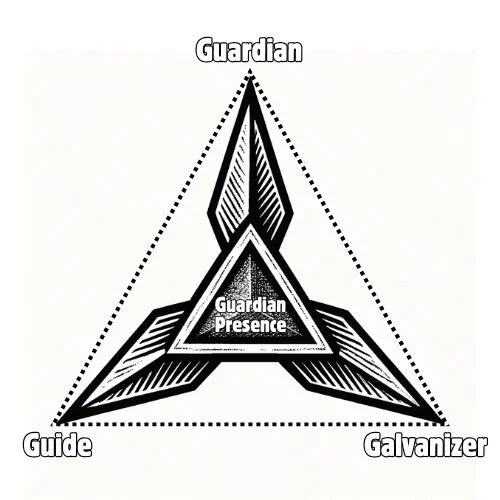
Diagram 2. Guardian Presence Triangle
Once we begin to see the three faces of drama—Threat, Prey, and Escape—we open the door to something stronger, steadier, and far more life-giving. The goal isn’t to shame ourselves for falling into survival roles. They’re ancient, automatic, and often invisible until named. The goal is to recognize when we’ve slipped into them and then choose a different way of moving through the tension.
David Emerald called this different way The Empowerment Dynamic (TED*). In the context of my coaching with couples, parents, individuals navigating major life transitions, and law enforcement professionals, I call this orientation Guardian Presence.
Where the old roles keep us reactive, stuck, and emotionally compressed, Guardian Presence offers a new center of gravity—one grounded in clarity, courage, and relational strength.
Guardian Presence is made up of three empowered roles that transform the Threat, Prey and Escape into grounded forces. The Survival Matrix does not need to have the final say or keep us sinking into the drama triangle. The three roles: the Guardian, the Galvanizer, and the Guide.
Here is an overview of the three Guardian Presence roles.
The Guardian — Choosing Agency and Alignment

The Guardian is the part of you that stands with clarity, agency, and intention. As the captain of the ship, the Guardian initiates decision-making and recognizes when Survival Matrix thinking is present. It turns to the Galvanizer and Guide resources to keep one’s bearing on true north.
Instead of collapsing into powerlessness or fighting from old wounds, the Guardian pauses, finds emotional grounding, and re-engages energized by values, integrity, and vision.
The Guardian asks:
What do I want in this moment?
What matters to me and what is my intention?
What is my responsibility—and what is not mine to carry?
Where the Prey feels helpless, the Guardian becomes a Creator. When it comes to their life, they are the conductor of the orchestra, the director of the production, and author of the story.
Where the Threat attacks, the Guardian responds with grounded strength, seeking self-awareness.
Where the Escape abandons the engagement or over-functions, the Guardian takes responsible action without taking over.
This role reminds us, “I can choose my response, even if I cannot choose my circumstances.”
The Galvanizer — Constructive Pressure That Builds Strength

Relationships and circumstances have inevitable friction—voices, challenges, situations, or feedback that expose gaps and invite greater honesty. The Galvanizer is that force.
The Galvanizer is not a critic or a fault-finder. Its truth-speaking is necessary as a Challenger, revealing blind spots or what is overlooked. It is the constructive pressure that strengthens.
It says:
This tension is trying to teach something.
There is courage that wants expression.
Lean into this moment—it is shaping and transformative.
Where the Threat uses pressure to shame or diminish, the Galvanizer applies pressure to develop.
Where the Prey shrinks under challenge, overwhelmed by criticism, the Galvanizer helps meet it with courage.
Where the Escape tries to remove discomfort and find relief at any cost, the Galvanizer invites growth.
This role reframes discomfort as a training ground of possibilities and newfound resilience. The Galvanizer believes in the courage latent within the Prey, so seeks to inspire confidence and brave action from the Guardian.
The Guide — Support Without Overstepping

The Guide is the presence that helps us slow down, notice what’s happening inside, and move forward with wisdom. The transformative Guide will feel like a therapist or mentor; a Coach who doesn’t fix or rescue but asks good questions. Temporary or inadequate fixes are seen for what they are as possibility-thinking comes into focus.
This role offers steady perspective, emotional containment, and clarity by reflecting on questions like:
What is actually happening here?
What core hurt is being triggered, and what is the current emotional need?
What are the possibilities of this opportunity?
Where the Escape removes responsibility, the Guide leans into it.
Where the Prey spirals inward or freezes under the stress, the Guide awakens us to the options we have and invites action.
Where the Threat escalates and intimidates, the Guide soothes and makes space.
This role nurtures growth without taking over the wheel from the Guardian or offering relief that is fleeting. The Guide values the agency of the Prey and invites the shift into Guardian thinking.
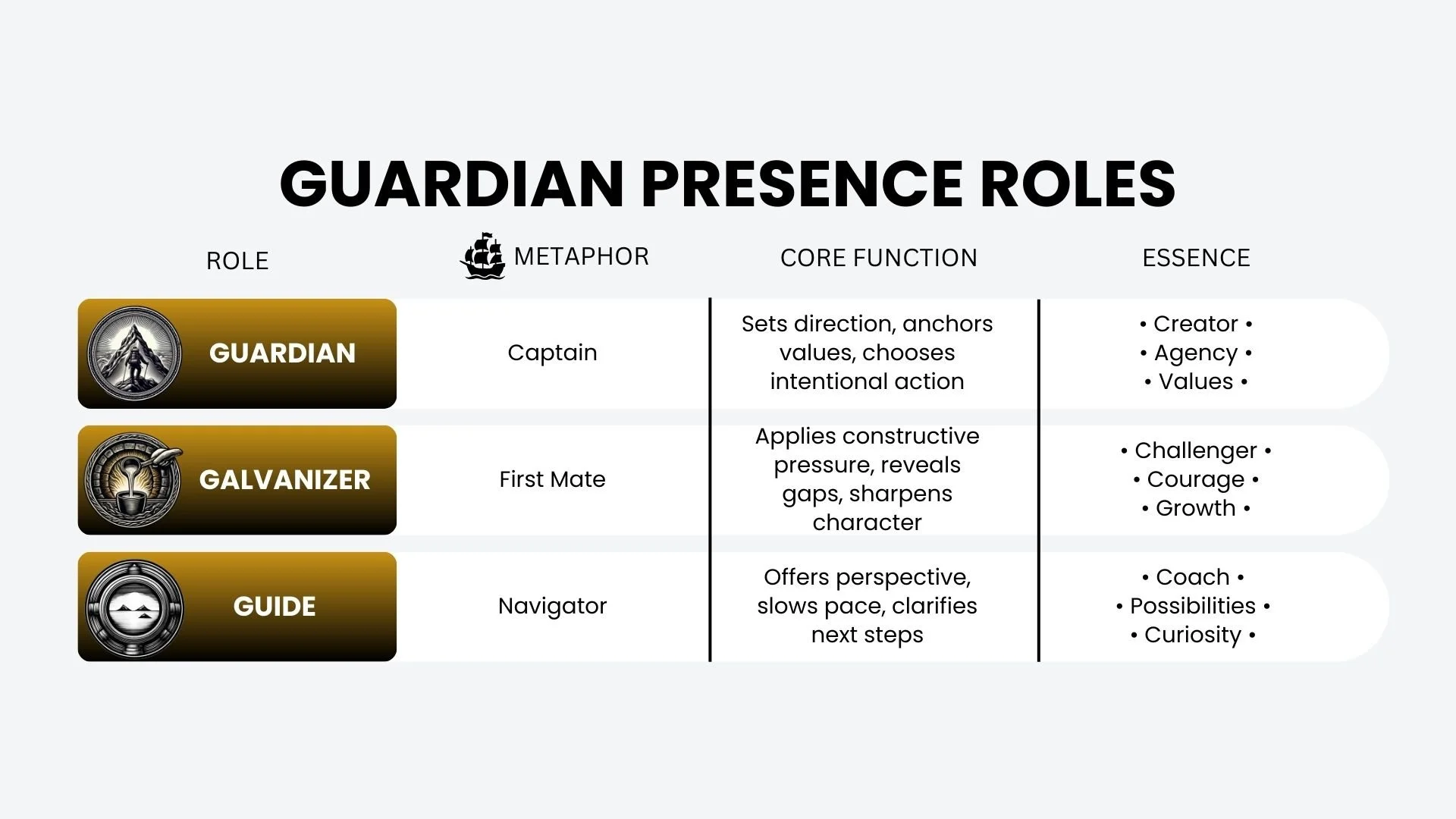
Chart 3. Comparison of Guardian Presence Roles
Leaving the Survival Matrix For Guardian Presence
So what does it look like to make the move from the drama triangle of the Survival Matrix into grounded and generative Guardian Presence?
As practiced in Part 1, it begins with awareness when the Threat-Prey-Escape energy is present. This is the first shift that must begin. From there, small intentional moments will nudge us toward the new orientation.
Navigating these moments is an essential part of the life coaching journey undertaken with clients. The mentor-mirror is invaluable in offering one who is attuned, alert, and quick-to-identify openings toward the new path. Whether working with another or encountering a situation solo, there are prompts that initiate Guardian Presence.
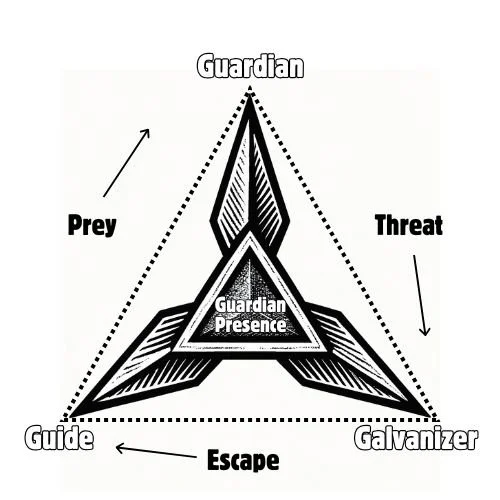
Diagram 3. Shift from Survival Matrix to Guardian Presence
Engaging the Guardian energy involves the creative questions, “What do I want?” and “What matters to me in this moment?” This stands in contrast to the limited question at the center of Prey-thinking, “Why is this happening to me?!”
Leaning into the Galvanizer energy is opening to the challenging questions, “What is the reality and truth that I must be aware?” and “How am I being challenged to grow?” Notice the difference from the Threat’s primary question of “What’s wrong with these people?” or “Why aren’t they doing what they know they should?”
Tapping the Guide energy begins with a posture of curiosity, “What are the possibilities and options?” and “How could I bring a creative response to this moment?” Escape thinking is about quick relief and rescue, “How do I fix this?” or “What can I do to calm things?”
As often shared with clients, we have built the Survival Matrix in a thousand ordinary moments. It will take a thousand new moments to build Guardian Presence. Today will offer an opportunity toward that new reality.
With this new orientation let’s return to the earlier examples where the Survival Matrix had trapped Jordan, James and Officer Daniels in the drama triangle.
What does Guardian Presence look like?
Re-visiting the Evening of Marital Disconnection
Jordan felt blamed (Prey), responded defensively (Threat), and then retreated into over-functioning or withdrawal (Escape).
Stepping into the Guardian role, Jordan notices the rising defensiveness and is ready to choose grounded presence. He asks, “What matters to me in this interaction?” Then he thinks, “I care about this relationship more than I care about being right. Let me stay aligned.”
He responds to his wife with a response drawing from the Guide role, “I hear you. It sounds like today has been heavy. Let me understand what feels hardest right now.” Notice how he is appealing to the Guardian within her, a subtle but important invitation for the other to relate from a grounded, fully present place.
This shifts the tone immediately.
Instead of seeing his wife’s comment as a critique and Threat, he considers her comment as a growth pressure from the perspective of the Galvanizer – “What’s the truth she is speaking right now?” He opens himself to the flash of an honest answer: “Something is off in our rhythm this week. She has been carrying a lot. This is a chance to course-correct and welcome her venting as something helpful.” In other words, Jordan allows the tension to highlight an opportunity to adjust expectations, renegotiate responsibilities, or communicate emotional needs.
In drawing from the strength of the Guardian Presence, Jordan shifts to an invitational pace. “Let’s sit for a moment—help me understand what’s going on, you have been carrying too much.” He gently and confidently leans in and the two of them have a chance to move forward in a dance where they are not carelessly stepping on one another’s feet.
Can you imagine how your spouse would respond if you changed the script and energy in this way?
Re-visiting the Tension With an Aging Father
James felt dismissed and overwhelmed (Prey), interpreted his father’s resistance as a personal attack (Threat), and then backed off to keep the peace (Escape).
James stepping into the Guardian role recognizes the familiar tightening in his chest and the impulse to withdraw or take over. Instead of reacting, he pauses internally and prompts himself with the question, “What do I want?” He remembers his deeper value and intention: “I want to honor my dad without losing myself. Let me stay grounded.”
With this posture, he responds with calm and clarity, “Dad, I hear you. I know you want to handle things on your own. My goal isn’t to take control from you—I just want to make sure you’re supported.” Immediately, the tone shifts—from defending roles to shared dignity.
What happened in that Guardian shift for James? Rather than interpreting his father’s irritation as a Threat, James allows the moment to function as a Galvanizer, “What is my dad actually trying to say (in his crusty way)?” He is able to reframe the tension, “Dad’s frustration is really about autonomy. He’s scared of losing independence. This is the part where I grow too—learning how to support him by checking in without demanding of and overwhelming him.”
The constructive pressure helps James adjust his approach rather than collapse under it. He becomes curious instead of reactive. James, as the Guardian, recognized the physical cues of the Threat and prompted himself to slow down and notice. He was then able to listen to his dad’s comment for the Galvanizing truth it held.
James then shifts into the Guide role rather than Escaping. Slowing the conversation and soothing the agitation level James asks, “Dad, can you help me understand what part of this feels frustrating? I want to get this right with you.” His tone is soft, invitational, and steady. He listens—not to fix, but to understand. In doing so, he becomes a safe and strong presence for his father, creating room for honesty without escalating defensiveness.
His sister comes in and asks, “How’s it going?”
James sitting next to his dad could answer with authenticity, “Really good!”
The energy shift was palpable and attractive. Where the Victim-Prey energy begets further Survival Matrix moments filled with drama, Guardian Presence energizes empowered moments.
Are you feeling the empowered energy available to you in conflict-filled moments?
Re-visiting the Supervisor Conflict
Officer Daniels felt criticized (Prey), viewed his sergeant as attacking and overly harsh (Threat), and tried to appease or withdraw by fixing the report quickly and avoiding conversation (Escape).
While walking out of the sergeant’s office, Daniels notices what’s happening—the spike in defensiveness, the heat rising in his chest, and the urge to shut down. All symptoms of the Prey energy. Daniels initiates his shift into Guardian role. Recognizing reactive mode is online, he takes a grounding breath, then silently asks himself a centering question: “What is the underlying value that has me so defensive?” He remembers his intention to bring excellence to his work, be valued by his workmates, even as he grows in his abilities. The reminder has a calming effect enabling him to shift into the Galvanizer-Guide and consider, “My sergeant can be crusty and direct, but it’s because he really cares about our work and my success.” His thought continues, “What is there for me to learn in this moment?”
A moment later Daniels turns around, knocks gently on the door and peers in, “Sorry about that, Sarge. My bad and not my finest moment. Help me understand what part of the report needs tightening up so I can correct it accurately.”
Where the Survival Matrix escalates tension, closes communication, and creates distance, Guardian Presence transforms the moment:
The Guardian stabilizes and chooses a values-based response.
The Galvanizer reframes pressure as growth, not threat.
The Guide regulates the moment, asks better questions, and makes constructive movement possible.
Again, from the place of Guardian Presence, we see the energy changes from reactive to grounded, from defensive to collaborative, from survival to strength.
From Drama to Presence: Next Steps In Your Journey
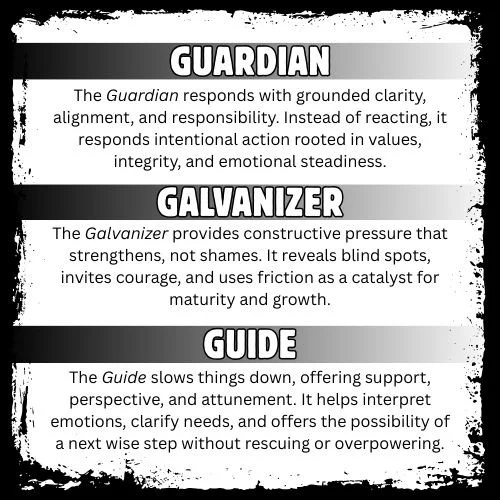
Chart 4. Guardian Presence Roles
There is a profound energy shift present when we move from the Survival Matrix to Guardian Presence. It is available to anyone who is motivated, curious and intentional.
As you read and consider these three empowered roles, consider a recent moment of tension in your life—at home, a family member, or at work. Ask yourself:
What would the Guardian have done differently in that moment?
Where was the Galvanizer inviting you to grow instead of react?
Was there a Guide—internal or external—you could have turned toward for clarity?
Guardian Presence doesn’t eliminate conflict and drama.
It transforms our engagement with it.
Instead of repeating inherited survival patterns, we begin creating a more grounded, intentional, and wholehearted way of living.
Closing Experimentations and Tasks
If you are reading this in preparation for our next coaching session, or for the Guardian Retreat take a small step toward implementing this concept.
1. Identify one recurring drama pattern at work, in marriage, with a parent, with a colleague. Where have you found Prey, Threat, and Escape roles showing up?
2. Track the roles for one week. Write a brief sentence each time you notice Prey, Threat, or Escape. What do you notice about what you feel and experience? Any other observations?
3. Revisit the Three Roles Inventory Card from earlier in the article. After 48 hours, return to the card and add one new observation about the Prey, Threat and Escape roles.
4. Bring your observations to our next session (or the Guardian Retreat). We will explore together how to build Guardian Presence in the small, ordinary moments where change actually takes root.
We built our Survival Matrix in a thousand ordinary moments.
We will build Guardian Presence the same way.
Your next empowered moment will come today.
Are you ready for the inspired view beyond the Prey-Threat-Escape Thinking of the Survival Matrix? Will you intentionally nudge your next work shift, argument, or parenting moment toward the Guardian-Galvanizer-Guide of Guardian Presence?